
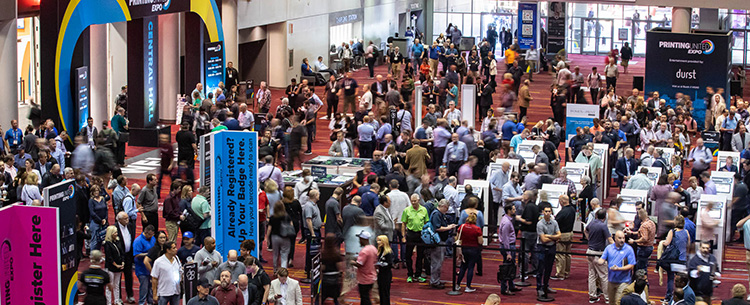
When a show’s as big as Printing United, it’s pretty much impossible to see everything. We always give it our best shot anyway.
Every year, Printing United Expo brings together some of the brightest minds, biggest brands, and most innovative technologies in the printing industry. For the SanMar Decorator Solutions team, it’s a chance to walk the show floor, connect with industry partners, and see firsthand what’s new, what’s next, and what could make a meaningful difference in your shop.
This year we focused on the decoration technologies most likely to help shops increase throughput, reduce labor, improve quality, and create new growth opportunities. There was one theme that stood out.

The Big Takeaway: Efficiency Means More Than Speed
Across all the innovations at Printing United, we saw that the future of apparel and product decoration is not simply faster machines. It’s building smarter production systems that solve real problems decorators face every day.
- Automated transfer application can reduce repetitive manual work.
- Direct-to-Mesh technology can simplify pre-press for screen printers.
- Automated inspection can catch defects before they lead to costly reprints.
- New approaches to cap and drinkware decoration can create opportunities to expand what your shop produces.
Each technology addresses a different challenge, but all share a common goal: helping decorators make better use of their time, labor, equipment, and resources.
Of course, not every new machine is the right investment for every shop. The strongest opportunities are the ones that solve a genuine operational bottleneck, support clear production goals, and deliver measurable value.
Let’s take a closer look at a few examples we saw at the show.

Small Transfers, Big Production Potential: The ROQ ID Press
When it comes to automation, bigger isn’t always better. Sometimes, the biggest opportunity is finding a more efficient way to handle the smaller jobs that keep your production floor moving.
Enter the ROQ ID Press, a compact companion to ROQ’s flagship Impress platform for automated heat transfer application. Designed specifically for smaller transfer placements, the ID Press is built for decorators handling high volumes of relabeling, sleeve graphics, and back-of-neck transfers.
With a maximum transfer area of 5.5” x 8.5”, the ID Press focuses on applications that don’t necessarily require a larger system. It has four independent heat press stations:
- One station for pre-pressing
- Two for transfer application
- One for post-pressing
Each station can be configured independently for time, temperature, and pressure, giving operators flexibility to accommodate different transfers and garment requirements.
The real attention-grabber is production speed—ROQ reports a capability of up to 500 garments per hour.
Automated feeding and peeling technology help reduce manual handling and deliver more consistent results, allowing team members to spend less time managing individual transfers and more time supporting production elsewhere.
Why it matters: For shops processing high volumes of relabeling or other small-format transfer work, automation can remove a production bottleneck without requiring a full size transfer system. A smaller footprint can still deliver a significant operational impact.

Rethinking Screen Making: Exile Technologies Hornet D2M
The finished print may get the attention, but the steps required to prepare a screen can have just as much influence on a shop’s productivity.
Exile Technologies is tackling that challenge with the Hornet Direct-to-Mesh (D2M) system, a technology designed to simplify the screen-making process by eliminating several traditional pre-press steps.
Skip coating an entire screen with photosensitive emulsion, exposing it, and washing out the image. Instead, the Hornet injects emulsion directly into the mesh only where it’s needed to create the stencil.
This imaging process can take up to eight minutes, depending on image size and complexity. But the steps you get to skip mean less reliance on traditional film positives, manual emulsion coating, exposure equipment, washout booths, and the drying time associated with conventional screen preparation.
Fewer preparation steps lead to less waiting, less water consumption, fewer materials to manage, and a more streamlined workflow between artwork approval and press time.
Why it matters: If your shop is looking to increase capacity, reducing the time and resources required to prepare screens deserves a closer look. Direct-to-Mesh technology offers a fundamentally different approach to one of screen printing’s most established processes and could reshape the pre-press workflow.
Quality Control Built to Scale: The M&R ICS 2.0
A fast press is great. A fast press producing hundreds of incorrect garments? Not so much.
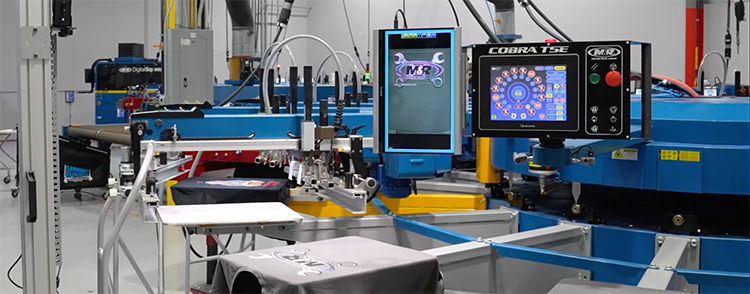
At the M&R booth, we got a look at the ICS 2.0 Image Capture Software System, an automated quality-control solution designed to help screen printers catch problems while a job is running, rather than discovering them after a stack of garments has already been printed.
Here’s how it works: The system captures an image of an approved print and compares subsequent prints against that standard throughout the production run. It can identify potential issues such as off-registration, pinholes, low ink coverage, and stray threads, helping operators recognize defects sooner.
The system uses a simple stoplight style indicator to communicate print quality:
- Green: The print meets acceptable standards.
- Yellow: A variation has been detected but remains within tolerance.
- Red: The print is outside the specified tolerance and requires attention.
By automating much of the visual inspection process, the ICS 2.0 can help shops reduce spoilage, minimize reprints, and maintain consistency across long production runs. It also serves as a valuable training tool, helping operators understand quality expectations and recognize issues more quickly.
The system can operate independently or integrate with M&R’s PASSPORTTM Automatic T-Shirt Unloader.
Why it matters: Quality control doesn’t just mean catching mistakes. Early detection keeps a relatively minor issue from becoming an expensive one. For high-volume decorators, automated print inspection can provide a valuable extra set of eyes on the production floor.

A New Spin on Cap Transfers: The M&R Horizon-H-1A
Speaking of automation, M&R also gave us a peek at something that’s still in the prototype stage: the Horizon-H-1A, a carousel-style system designed to apply heat transfers to the fronts of caps.
It features a carousel that holds four caps and rotates them through the transfer application process. Rather than handling each cap individually, operators can potentially use the rotating system to streamline their cap decoration workflow.
It’s an interesting development for shops looking to expand or improve their headwear production capabilities, particularly as they explore ways to automate more of the decoration process.
The Horizon-H-1A is still a prototype, so we’re looking forward to hearing what M&R has to share at a future decorator show. Consider this one firmly on our watch list.
Why it matters: Caps create distinct challenges in positioning, handling, and transfer consistency. A purpose-built automated system could give decorators another way to improve efficiency in a category that requires a different approach from standard flat-garment decoration.

What’s Next for Drinkware: GPE Ardenghi
Drinkware is a category we’re keeping an eye on as decorators look ahead to 2027, so finding GPE Ardenghi right next to the SanMar booth was a welcome opportunity to explore what’s possible in cylindrical printing.
Founded in Italy in 1945, GPE Ardenghi specializes in industrial screen printing equipment designed for curved and hollow objects. Its machines can print directly onto products such as bottles, cups, jars, cosmetic tubes, pens, syringes, and other cylindrical or curved components.
The company’s equipment ranges from compact, semi-automatic benchtop machines suited to shorter runs to fully automated, multicolor carousel systems with integrated UV or LED curing. For decorators considering larger-scale production, industrial models like the GPE100 line are designed to reach reported speeds of 2,500 to 3,000+ pieces per hour, with automatic loading and unloading available on some configurations.
That’s a significant production capability for businesses looking beyond traditional apparel and exploring the opportunities presented by drinkware.
Of course, equipment selection depends on the product, artwork, number of colors, production requirements, and available space. But for shops looking to diversify their offerings, cylindrical screen printing is a category worth investigating.
Why it matters: As decorators explore new product categories, the right equipment can mean the difference between handling occasional specialty jobs and building a scalable new revenue stream. With drinkware on our radar for 2027, GPE Ardenghi’s technology gave us plenty to consider.
That’s a Wrap, For Now
The SanMar Decorator Solutions team believes staying informed about emerging technology is an important part of helping decorators make confident investment decisions.
That’s why we prioritize time on the show floor, conversations with equipment partners, and a closer look at the innovations that could matter to your business. Printing United 2026 gave us plenty of new ideas, and we’ve only scratched the surface.
For more industry insights, emerging technologies, and practical ideas to help your shop work smarter and prepare for what’s next, contact the Decorator Solutions team. We’re here to help.