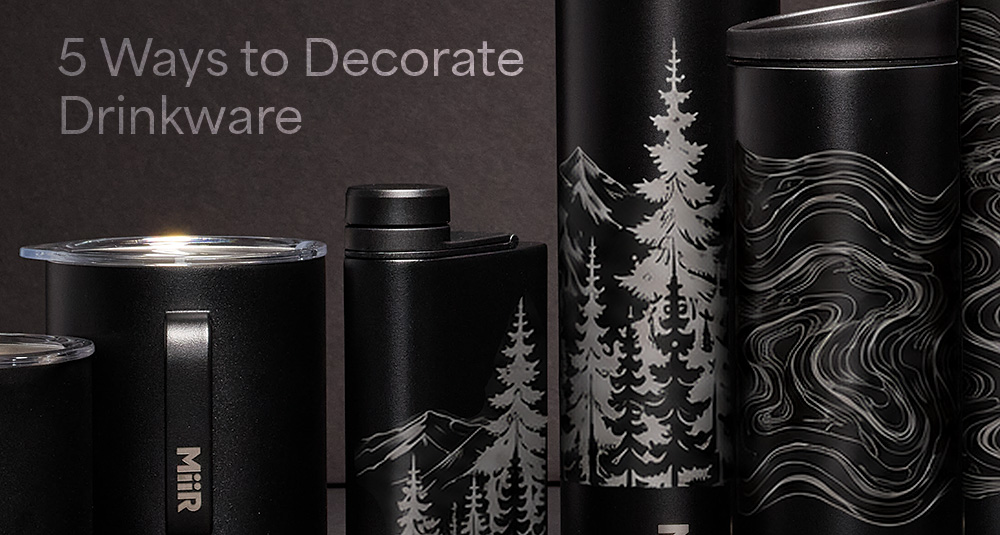
For contract decorators used to working with apparel, the next natural evolutionary step is often drinkware.
In the promotional industry, drinkware consistently ranks as the #2 category customers are looking for. It allows decorators to support merchandise programs while applying familiar disciplines such as artwork preparation, color management, production scheduling, quality control, and fulfillment.

However, decorating a tumbler, bottle or camp cup isn’t the same as decorating a t-shirt. Some of the equipment is similar, but the shape, coating, and substrate of the product can affect everything from equipment selection to ink adhesion and wash durability.
Before investing, decorators should understand the major decoration technologies, the applications each one handles best, and the production model that fits their business.
The right technique for your business depends on the work you expect to sell.
- Laser engraving supports durable personalization on coated metal and often can match a retail brand’s existing logo.
- UV printing is suited to full-color and full-wrap graphics.
- UV DTF decals offer tactile effects and the option to begin with outsourced transfers.
- Screen printing and pad printing align with larger spot-color programs.
Keep reading to learn about the pros and cons of each method.
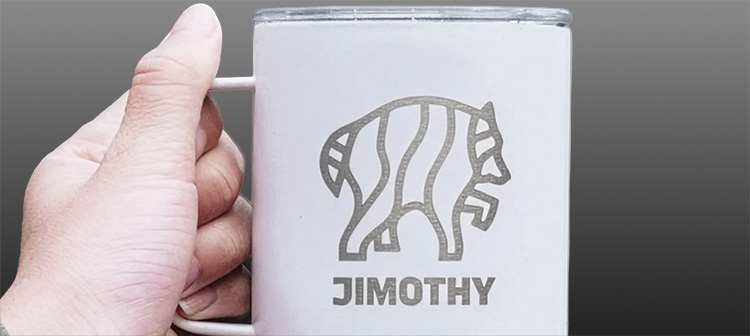
Laser engraving: Let the artwork shine
Laser engraving removes the exterior powder-coated finish on metallic drinkware to reveal the metal beneath, producing a detailed, single-color image. It is not intended for plastic drinkware.
Laser-engraved drinkware is highly durable, dishwasher-safe, well suited for personalization, and almost ideal for smaller production runs.
There are a few types of laser systems to consider:
- Gantry-style CO2 systems offer versatility and a more accessible equipment path, but are a bit slower.
- CO2 Galvo lasers provide faster production at a higher equipment cost.
- Fiber lasers are positioned for high-volume commercial production, fine detail, and direct engraving on bare stainless steel or stripped metal.
CO2 lasers are commonly used for standard powder-coated drinkware because they cleanly remove the coating. They may also be used to etch glass and wood accents, and with the right equipment, laser systems can also create full-wrap etched designs.
Industry laser equipment providers include:
The equipment they provide range from rotary-equipped platform systems to open-frame CO2 Galvo solutions designed with drinkware accessories in mind.

UV printing: Limitless wraparound color
UV printing is a strong option when customers want highly detailed, full-color graphics rather than a single-color engraved appearance.
Cylindrical UV printers equipped with 360-degree rotary capability can produce full-wrap designs on powder-coated and plastic drinkware. Some equipment can also build layers of clear varnish to create raised textures or dimensional effects.
Flatbed UV printers may support non-cylindrical items such as flasks, although their printable area is limited on rounded surfaces.
For UV drinkware printing, be on the lookout for three particular equipment features:
- Taper Compensation – Essential to print cone shaped or flared styles
- White and Gloss Channels – White ink provides a solid base layer so colors pop on metallic or dark coated cups, while gloss creates raised 3D textures.
- Onboard/Inline Primer – Helps the UV ink bond permanently to slick polymer or powder-coated surfaces
UV equipment providers include:
- Roland DGA
- Inkcups
- Innovative Digital Systems
- Direct Color Systems
- STS Inks
- Boston Industrial Solutions
The equipment covers entry-level applications, rotary cylindrical printing, and higher-speed industrial production.

UV DTF decals: No heat required
UV DTF decals offer a different way to decorate drinkware. They’re designed for high-density, tactile images and can include metallic effects, gradients, small text, and white ink layers.
You apply these decals the old-fashioned way—with pressure and a squeegee. There’s no heat press or oven, and no weeding step. The finished decoration is scratch-resistant and waterproof, although handwashing is recommended to extend its lifespan.
This method provides two possible operating models. Decorators can purchase finished transfers or invest in equipment to manufacture UV DTF decals internally.
Finished transfer providers:
Providers of manufacturing equipment:
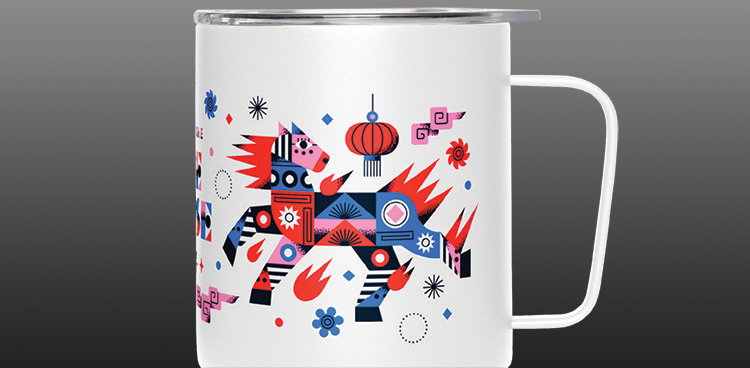
Screen printing: Built for bold color
Cylindrical screen printing works best for larger runs and spot-color logos. You can use it on powder-coated and plastic substrates. For plastic drinkware, you may need specialized UV-cured inks.
You may also need drinkware-specific equipment and compatible ink systems. Make sure your customer is aware that screen printed artwork doesn’t do great in the dishwasher. If they want designs that will stay crisp without the hassle of handwashing, another method is probably a better option.
Here’s some equipment you’ll want to consider:
- A curved or roller cradle that rotates the product smoothly
- An adjustable squeegee or pressure head for consistent contact
- Appropriate clearance for handles
Camp cups may require specialized screens or fixtures that index around the handle. Compatibility with two-part epoxy, solvent or UV-curable inks is also important for creating a print that resists scratching.
Equipment sources, including options intended for high-speed industrial production, are:

Pad printing: A durable, detailed finish
Pad printing is another high-volume option for spot-color decoration. It can reproduce fine lines and detailed artwork and, depending on the equipment, support multiple colors.
The finished decoration can be dishwasher-safe when the industrial two-part inks are properly cured. The process works with powder-coated and plastic substrates and is particularly appropriate for larger runs.
A complete setup may require:
- Plate-etching equipment
- Curing systems
- Custom fixtures
Sealed ink cups help maintain consistent ink viscosity, while sufficient compression allows the silicone pad to conform around curved or tapered drinkware. Multi-color work also requires accurate slide or shuttle mechanisms to maintain color-to-color registration.
Pad-print equipment providers include:
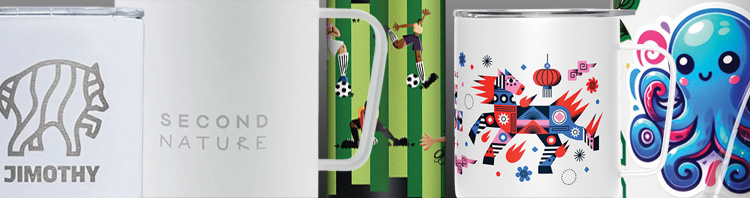
Before you buy equipment, remember…
- Evaluate your typical order quantities, product materials, artwork requirements, wash expectations, and need for personalization.
- Test products, coatings, inks, and curing methods.
We’re here to help!
The Decorator Solutions team can help NDNL and PSST contract decorators connect with affiliates and industry resources, to continue evolving their business to produce beautifully decorated drinkware.
To obtain supplier contact information, schedule a Deco Talk, or discuss which decoration model may fit your operation, contact decoratorrelations@sanmar.com.